
Imagine somewhere · 5 min read
Build an imaginary world with your child
A whole universe is a lot to invent. A place with three interesting spots is enough. Give your character somewhere to go, something to notice and one rule that makes this world different.
Try this together
One little idea for right now
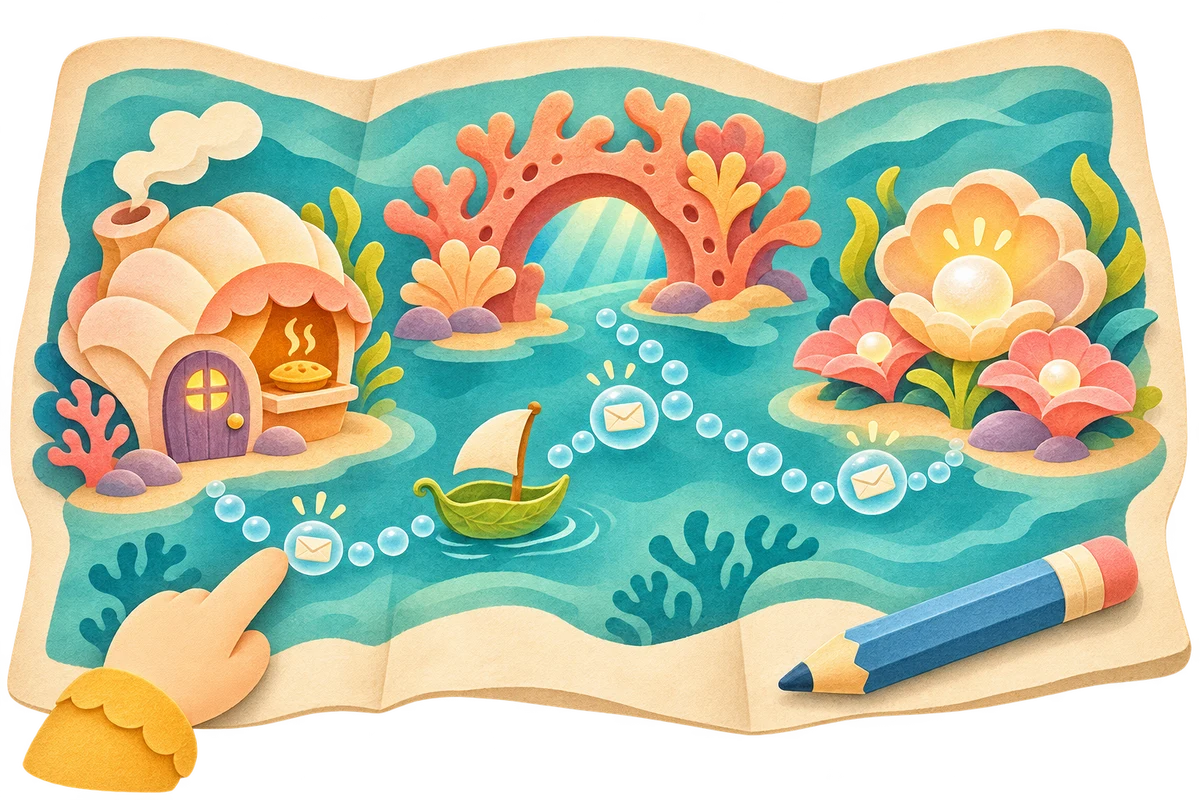
Draw three circles and connect them with a path. Name a home, a strange place and somewhere a friend might need help. Ask which spot to visit first.
- Time to play
- 10–20 minutes
- What you need
- Paper and pencils or our free world-map sheet.
Start with three landmarks
Somewhere familiar
A home, meeting place or comfortable corner gives the character a place to start and return. What makes it feel like theirs?
A shell-shaped kitchen with a little purple door.
Somewhere surprising
Pick one broad, memorable feature. A singing cliff is easier to use in a story than twenty named mountains.
A coral arch that hums when the tide turns.
Somewhere with a possibility
A place can offer a small task, a visitor or a question. It need not be dangerous.
A pearl garden where one light has gone out.
Choose one unusual rule
Try ‘Bubbles carry messages’ or ‘The bridges move when someone laughs.’ Ask what that changes for a visitor. The rule becomes useful when it affects a choice, rather than staying a fact on a map.
Keep it to one rule for now. If bubbles carry messages, a popped bubble might lose a delivery. Your character has something to try. Add more rules only when you want them.
Notice the world with more than your eyes
A sound
Does the path crunch, ring or whisper? Make the sound together. It can tell a visitor which way to go.
A feeling
Is the stone warm, springy or smooth? A child can describe it with a gesture. Choose one detail instead of filling every sense.
A small everyday need
Where do people rest, get food or meet a friend? An ordinary need helps an impossible world feel usable.
A tiny adventure through the map
Dumpling leaves the shell kitchen with a message bubble. At the humming arch, she hears that the pearl garden is dark. She wants to send for Fork Duck, but the message bubble sticks to a seaweed leaf. What could she try?
Let your child choose the next stop or draw the route. If the map changes halfway through, redraw the path. You are building a place to play in, not surveying a real island.
Same friend, a very different place
Move a familiar character to a paper forest, a felt cloud village or an underwater bay. Keep two recognisable traits and change what the setting asks of them. A friend with purple feet might need fins; a careful walker might discover floating.
Ask ‘What can our friend do here that they couldn’t do at home?’ and ‘What familiar thing would they miss?’ One different rule can lead to a new story without inventing another cast.
Leave a blank space for later
Use the printable map to name three places, mark a path and write or draw your world’s rule. Leave one area empty. Next time, ask what is beyond the edge rather than adding detail everywhere today.
In FableBunch, describe the world’s main landmarks, atmosphere and rule in words. Bring your character into a story set there. A paper map can guide those descriptions; no upload or automatic map conversion is required.
Take the idea to the kitchen table
Open the free printable sheet, then print it or save it as a PDF using your browser’s print dialog. No sign-up needed.
Open printableA few parent questions
Does a story world need a map?
No. Describe it aloud, arrange three toys or name places during a walk. A map is one way to keep track; it is not a requirement for world-building.
How detailed should our world be?
Detailed enough for the next little adventure. Three places and one unusual rule are a useful starting suggestion. Add more only when it makes the play more enjoyable.