
Start here · 6 min read
How to make up a story with your child
You don’t need a brilliant plot. One unusual friend, somewhere to go and a small thing to solve are enough. Your job is to leave space for your child’s ideas—even the gloriously odd ones.
Try this together
One little idea for right now
Ask: ‘Who lives in a place where the rain falls upwards?’ Let your child name someone. Ask what that friend needs today. You’ve started.
- Time to play
- 5–15 minutes
- What you need
- Your voices. Paper and pencils if you like.
Five questions, one little adventure
Take turns answering these questions. A word, a gesture or a drawing counts as an answer. Follow an interesting detour; this is a handrail, not a test.
Who is here?
Choose one character and one memorable detail. Resist building a whole cast before anything happens.
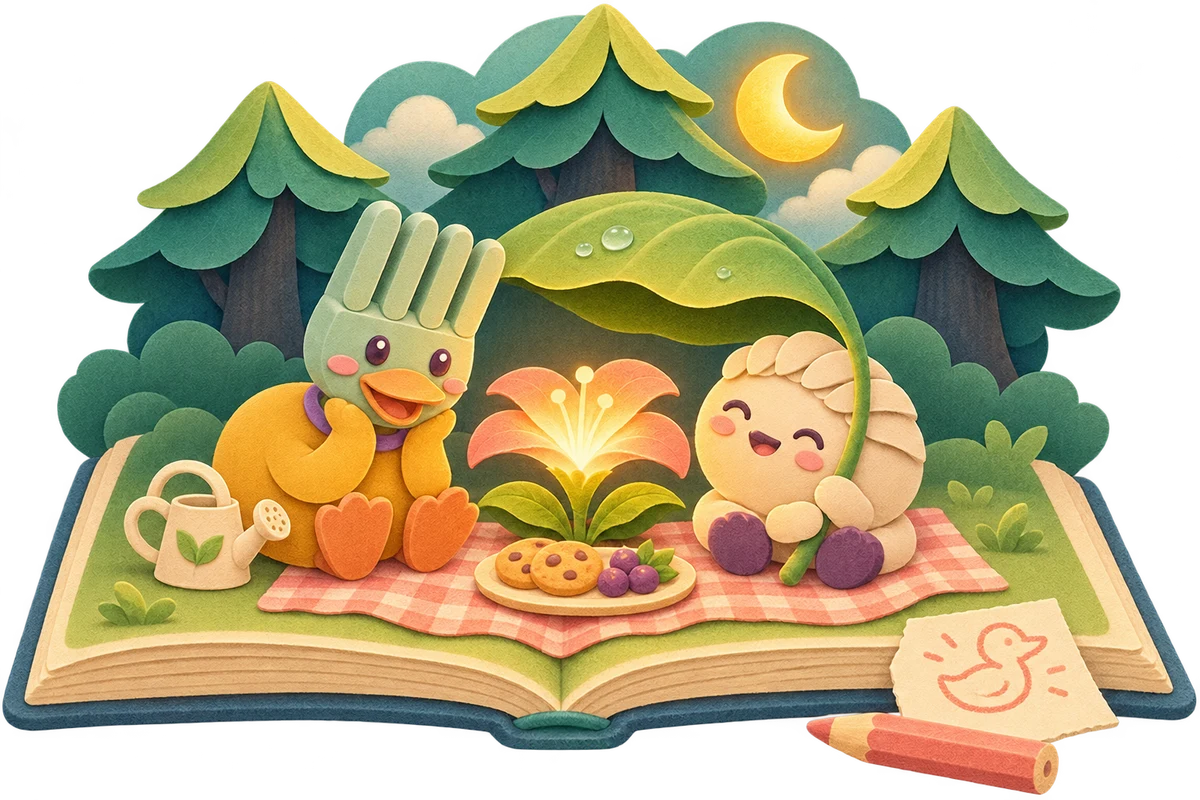
‘Fork Duck has a green fork for a head. What is he carrying?’ — ‘A watering can!’
Where are they?
Name one place and something you can see or hear there.
‘He’s in Moonflower Forest. The flowers ring like tiny bells.’
What do they want?
Pick a small, understandable problem. Lost mittens can be as interesting as a missing moon.
‘The smallest flower won’t open before the moon picnic.’
What could they try?
Let the first attempt be imperfect. Ask your child to choose what happens next.
‘Water didn’t work. Should Duck ask Dumpling or sing to the flower?’
What changes?
Give the choice a consequence and somewhere to pause. A quiet ending is an ending.
‘Dumpling shades the flower with a leaf. It opens, and they share the picnic underneath.’
What that sounds like as a story
Fork Duck carried a watering can through Moonflower Forest. Every flower chimed except the smallest one. The moon picnic was about to begin, and its petals were still shut. Duck gave it a careful drink. Nothing happened.
‘Maybe it’s too bright,’ said Dumpling. She held a broad leaf above it. One petal curled out, then another. Inside was a little pool of moonlight. Duck put down the can. They moved their picnic under the leaf, where the smallest flower made the biggest glow.
When the answer is ‘I don’t know’
Offer two real choices
‘Does the parcel make a squeak or a snore?’ is easier to answer than ‘What happens?’ Accept a third idea too.
Let a prop answer
Hold up a toy, point to a doodle or make a sound. Your child can choose without speaking. An adult can narrate the choice without changing it.
Model one short turn
Say one sentence, then pause. ‘I think the bridge is ticklish.’ Leave the next decision open instead of finishing the adventure yourself.
Make room for different storytellers
For a child who prefers drawing, sketch three moments while you write down their words. For a confident teller, ask what the other character thinks or let them invent a different ending. For siblings, give each person a turn to choose; anyone may pass.
Use whichever family language makes the idea easiest to express. There’s no need to correct every sentence during the telling. You can repeat an idea naturally and ask whether you understood it.
Keep the bit you want to return to
Write the title, draw the favourite moment or make a short note of the character’s unfinished wish. Next time, begin with ‘Yesterday, Duck discovered…’ and invite your child to correct you.
In FableBunch, a parent can describe a character, create a world and use those ideas for a story. Your paper drawings can inspire the descriptions; the app does not convert uploaded drawings. Read the result together and decide what your family wants to keep or try next.
Take the idea to the kitchen table
Open the free printable sheet, then print it or save it as a PDF using your browser’s print dialog. No sign-up needed.
Open printableA few parent questions
Does my child need to be able to write?
No. Tell it aloud, act it out or draw. You can write down the words your child chooses. The activity is shared invention, not handwriting practice.
What if the story makes no sense?
Ask one curious question: ‘How did the snail get there?’ If your child likes the answer, continue. You do not need to repair every jump or insist on a tidy plot.
How long should our story be?
A few sentences can be enough. Stop when interest fades. Keep one unfinished question if you both want to return; you do not have to finish in one sitting.